RESEARCH / FIELD EVIDENCE
Load and PV forecasting: deployment to validation
Turn deployed forecasting functions into comparable, reproducible energy-research questions.
Updated: 25 October 2026
Research question
How do forecasting errors affect storage reserves, demand peaks and charging schedules? Beyond average accuracy, the research questions cover day types, variable PV, sudden demand changes and transfer across resources.
Research leadership and approach
Luo leads the team in deploying load and PV forecasting alongside measured energy information in the EMS. Further research can connect measurement-quality checks, chronological evaluation and baseline comparisons with the effect of forecasts on energy-management decisions.
Implemented work and scope
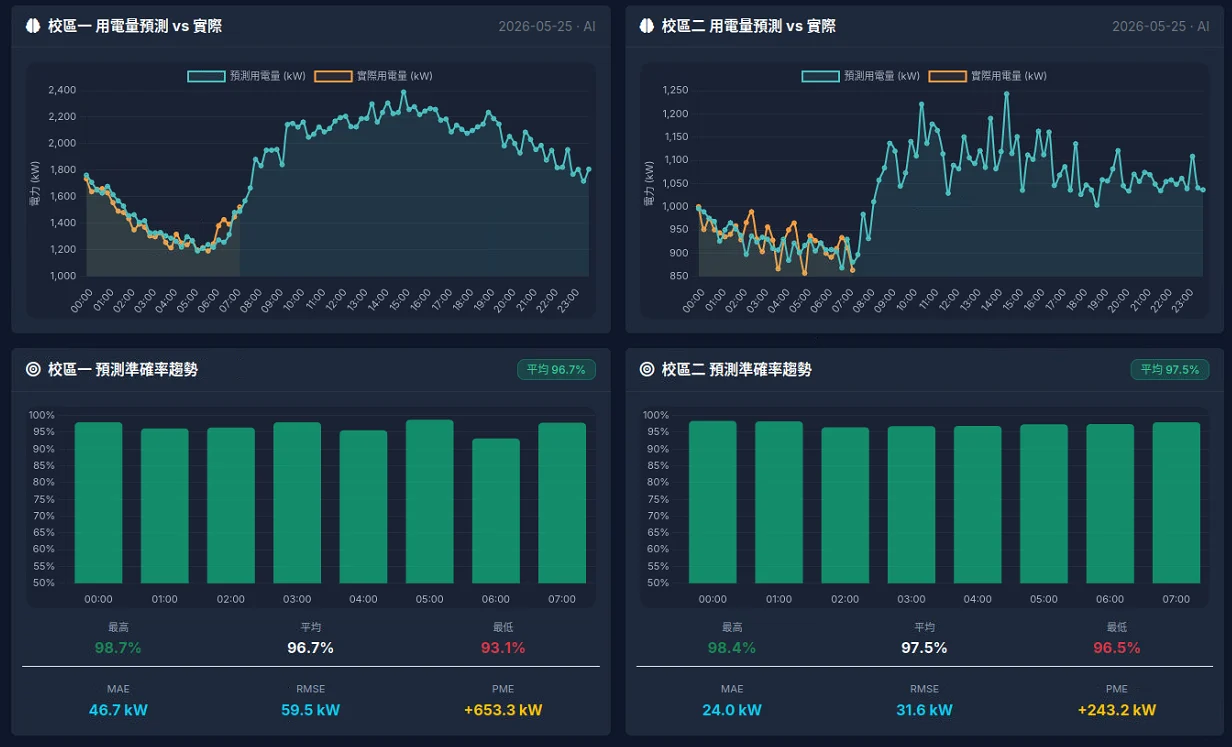
Load and PV generation forecasting are deployed. The site retains a display from an exchange presentation; its interface metrics are not evidence of long-term or cross-site accuracy. Coverage, sampling intervals, missingness, forecast horizons and model versions need to be established before a joint study. Cross-site validation is not claimed.
A proposed collaborative study
Start with a cross-season load and PV forecasting benchmark. Use chronological train/test splits to avoid future-information leakage; compare persistence or seasonal baselines against deployed models using MAE, RMSE and peak-period errors. Offline simulation can then assess storage-scheduling consequences. Probabilistic forecasting and cross-site transfer can follow if data quality permits.