RESEARCH / FIELD EVIDENCE
PV–storage–charging integration and islanded operation
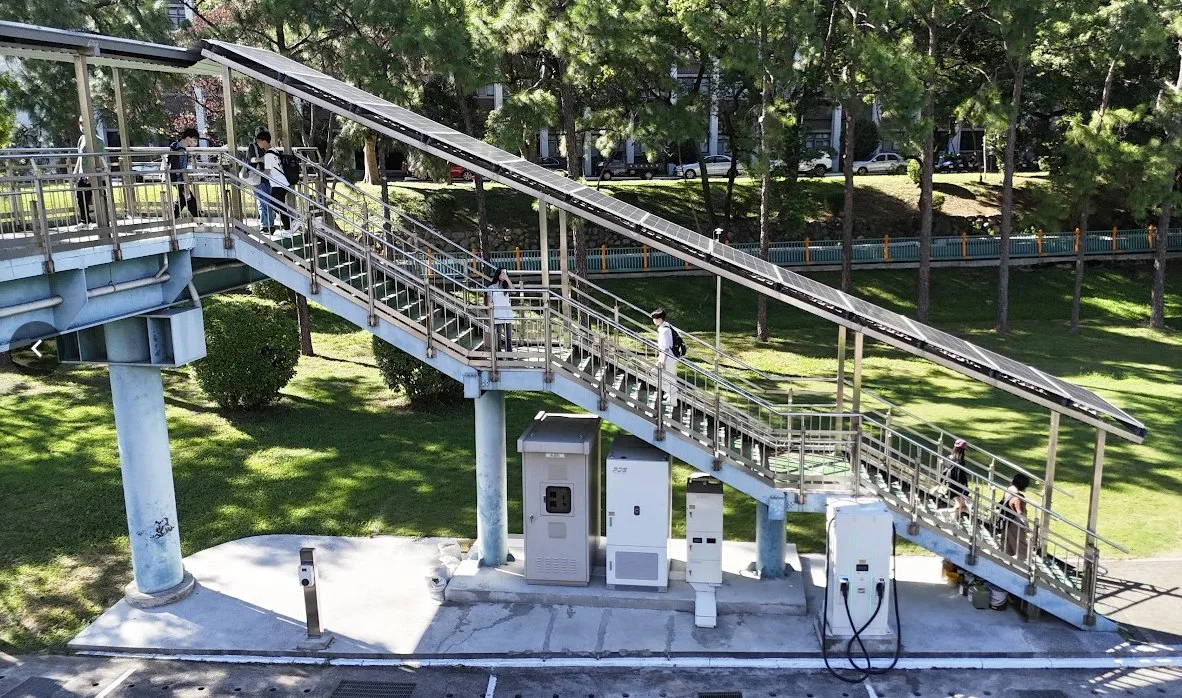
The bridge microgrid provides a field basis for studying variable generation, storage capacity and charging service.
Updated: 25 October 2026
Research question
When charging demand and PV output do not coincide, how can charging service and storage reserves be balanced? Campus use connects capacity planning, energy balance and the risk of interrupted service in one research question.
Research leadership and approach
As principal investigator of the site-related projects, Ching-Chuan Luo leads the team with partners in planning, deployment and integration. The bridge system combines 30 kW PV, 100 kW / 200 kWh storage, one 180 kW-total DC charging station and five 7 kW AC chargers. Equipment integration and operating records connect energy management with charging applications.
Implemented work and scope
The site accumulated approximately six months without grid-parallel connection while supplying DC and AC charging. Battery depletion caused a supply interruption, followed by restoration after reconnection; this is not a six-month uninterrupted-supply claim. One EMS monitors the three campus resources, with manual operation. A related paper separately documents a PV–storage and OCPP charging proof of concept; its test scope should be distinguished from this operating history.
A proposed collaborative study
A proposed study is storage reserves and service adequacy under uncertain charging demand. Reconstruct energy balances from approved historical data, compare manual operation, rule-based strategies and optimized schedules, then evaluate minimum SOC, unserved energy and charging-service fulfilment. These are proposed evaluation metrics, not demonstrated improvements.